UNCLASSIFIABLE
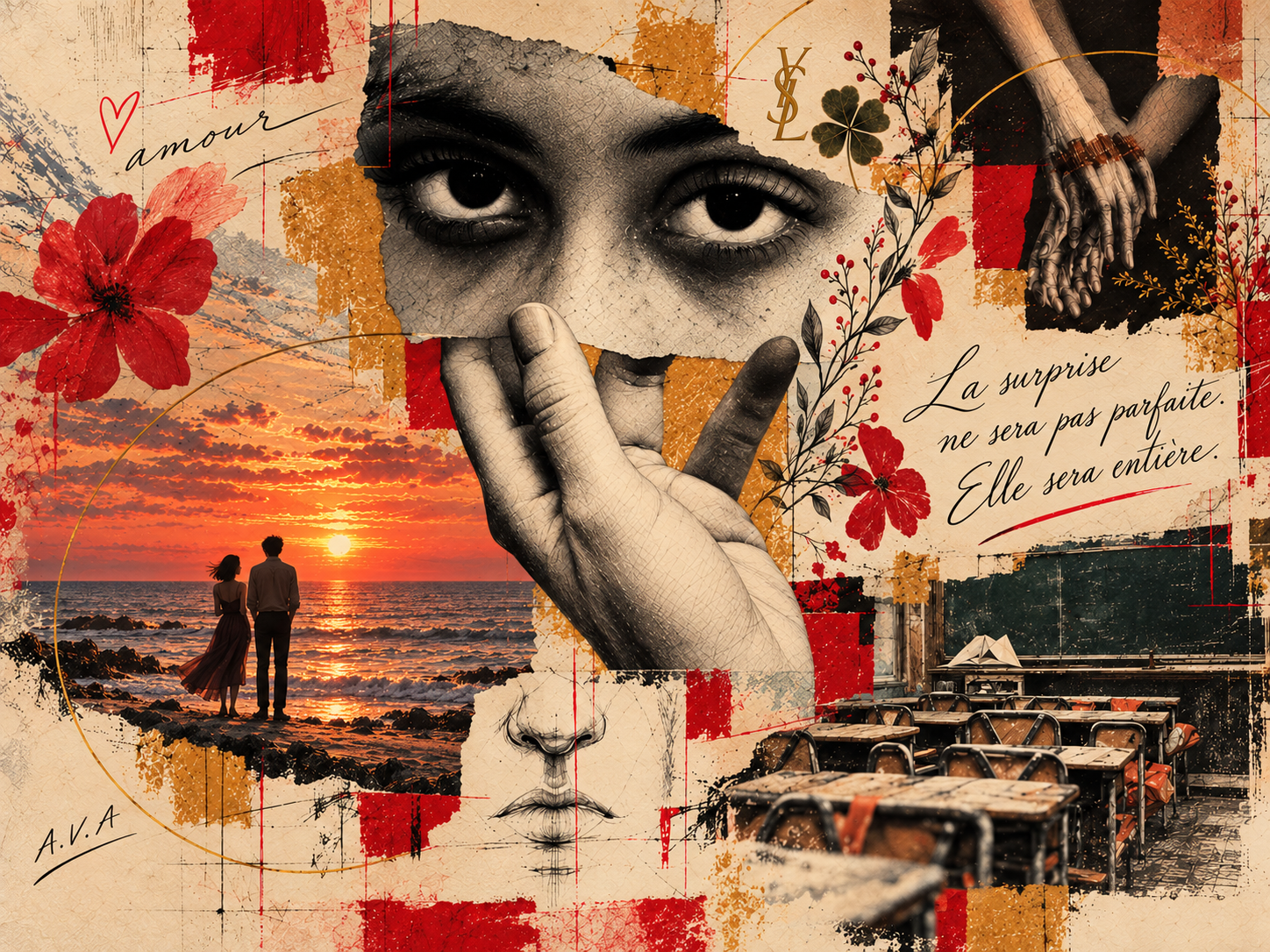
There are evenings when we would like everything to be perfect.
The right table. The right light. The right words, spoken at exactly the right moment, with that carefully rehearsed nonchalance that sometimes requires three days of planning and two changes of clothes.
We would like to be spontaneous, methodically.
Romantic without being ridiculous.
Brilliant without appearing to want to shine.
Vulnerable, certainly, but within reasonable proportions and preferably under flattering lighting.
Sometimes, an October evening is all it takes to reveal all of this.
The city lights up earlier. Café terraces draw closer together. The rain hesitates with that slightly irritating elegance that can turn a simple walk into a negotiation.
And yet we continue trying to control every detail.
As though happiness could arrive exactly on schedule.
As though love itself were expected to follow the programme.
We spend a considerable part of our lives arranging the staging of a character we call “me.”
A reasonably convincing character.
He works. He loves. He doubts discreetly. He makes confident statements. He occasionally posts photographs in which, by a remarkable coincidence, his life always seems to unfold at the best possible time of day.
And then something happens.
One detail slips away from the script.
The reservation does not exist.
The bouquet has seen better days.
The rain finally decides to join us without having been invited.
And the wonderful sentence we had prepared disappears at precisely the moment we were supposed to say it.
Then something strange happens.
We stop performing. We laugh. We look at the other person. We are there.
The surprise will not be perfect, but whole.
Perhaps that is what we sometimes lack the most.
Not more perfection. More presence.
And behind all the answers we give the world remains a question we carefully avoid.
Who am I when I no longer need to impress anyone?
The question seems intimate. It may be much bigger than that.
We have been creating avatars since long before social media was invented.
There is the strong woman, the man who knows, the impeccable lawyer, the successful one, the reassuring one, the one who keeps everyone laughing even when he no longer feels much like laughing himself.
These characters are not false.
They are simply incomplete.
The problem begins when we forget that they tell only part of our story.
Then a particular kind of exhaustion appears.
The exhaustion of having to continue being the person everyone else has grown accustomed to meeting.
And then one day, something shifts.
A battle that once seemed essential no longer deserves our energy.
A certainty cracks. A new desire appears.
And this sentence emerges.
This no longer corresponds to the person I want to be.
The people around us may be surprised. We should understand them.
Sometimes we have just changed our personality without observing the notice period.
And yet a living identity evolves.
It contains strength and vulnerability, courage and fear, light and shadow, certainty and doubt.
Changing does not necessarily mean abandoning the house.
Sometimes it simply means discovering that it was far larger than we had imagined.
And that, at the end of the corridor, a door had been waiting there all along.
Researcher Donald Hoffman proposes an idea that is as fascinating as it is unsettling.
According to his Interface theory of perception, evolution may not necessarily have shaped us to perceive reality faithfully, but rather to perceive what enables us to act, decide and, above all, survive.
Imagine a video game.
You move through a perfectly coherent world.
A road. A forest. A city. An energy bar that falls with an honesty that can occasionally feel rather insulting.
Everything seems real inside the game.
And yet behind the forest, there are no trees.
Behind the city, there are no streets.
And behind the energy bar, fortunately, there is no doctor on call.
There is code.
The screen does not show you the calculations or the millions of operations that make the experience possible.
It shows you what you need in order to play.
What if our perception worked, allowing for all the obvious differences, in a comparable way?
Perhaps we see the interface, rather than the entire reality that makes it possible.
Hoffman takes this intuition further by exploring the hypothesis of fundamental consciousness and networks of conscious agents.
But let us immediately keep one word in mind.
Hypothesis.
Not revelation.
Not a truth carved somewhere into space-time.
These ideas remain debated. And that is precisely what makes them interesting.
They force us to accept a rather less comfortable possibility.
Perhaps we do not know everything.
And yet we spend a large part of our lives behaving as though we had understood the rules of the game perfectly.
Move forward. Level up. Unlock a few rewards. Occasionally compare our score with the neighbour’s.
And almost forget what matters most.
Are we the player, the avatar, or simply very attached to the score displayed on the screen?
We still do not know exactly what consciousness is.
That does not seem to prevent us from building increasingly intelligent machines.
One has to admire our species for a certain amount of flair.
We still do not know the code, but we are already looking for the administrator password.
Artificial intelligence, autonomous agents, avatars, virtual worlds, superintelligence.
The tools change. The temptation is very old.
Understand. Control. Create.
But the more powerful our tools become, the more an old question returns.
What do we do with this power?
The law has an almost endearing quality here.
While philosophy asks whether a machine might one day become conscious, the law begins by asking who informs, who decides and who answers for the consequences.
Since 2 August 2026, certain transparency obligations under the European Union’s Artificial Intelligence Act have become applicable, including in relation to certain interactions with AI systems and certain artificially generated or manipulated content.
It is less spectacular than the birth of a new god.
But when something goes wrong, metaphysical vertigo generally finds its lawyer’s telephone number surprisingly quickly.
Power does not eliminate responsibility.
It enlarges it.
And perhaps the real question is not simply how far our tools will be able to go.
But who we want to become while using them.
Which brings us, rather unexpectedly, back to a much older technology.
Love.
We do not only create a representation of ourselves.
We also create one of the people we love.
We meet someone. We observe them. We listen to them.
Then, very quietly, we begin constructing our own version of that person.
It is reassuring.
Until the day the actual human being decides to stop following the script.
They change. They hesitate. They abandon certain battles. They discover new desires.
And sometimes we discover a slightly embarrassing truth.
What we missed was not always the person. It was the idea we had created of them.
Perhaps loving someone means something far more courageous than knowing them by heart.
Besides, “knowing someone by heart” is a curious expression.
As though the person we love were a poem that must be recited without making a mistake.
True romance may be precisely the opposite.
Continuing to discover someone even after we thought we knew them.
Allowing them the right to change. To surprise us.
To be strong on Monday and vulnerable on Tuesday without having to call an extraordinary general meeting.
Not to impress.
Not to possess.
Not to win.
Not always to be right.
To meet.
Perhaps that is what presence really means.
Accepting that the best moment may not necessarily be the one we had planned.
That the rain may invite itself.
That the bouquet may no longer be perfectly straight.
That the script may go slightly wrong.
And that something far more precious may appear at precisely that moment.
The other person as they truly are.
One day, a Mask, a Mirror and a Door were discussing human beings.
The Mask spoke first.
It was used to doing so.
— Thanks to me, they know what to show the world.
The Mirror smiled.
— Thanks to me, they know who they believe themselves to be.
The Door said nothing.
Its silence eventually irritated the other two.
— And you, asked the Mask, what use are you if you show nothing?
The Door remained silent.
The Mirror gave a small laugh.
— This promises to be a fascinating conversation.
The Mask then set about explaining human beings. Their roles, their successes, their carefully concealed weaknesses, everything they felt they had to show in order to be loved, admired, or simply left alone.
The Mirror continued. It spoke of identity, image, reflection, and all the versions of ourselves that we sometimes end up mistaking for the only possible one.
The conversation then became scholarly. Then complicated. Then almost incomprehensible.
Which is often the precise moment when everyone becomes absolutely certain that they are right.
A child arrived.
He looked at the Mask. Then the Mirror. Then the Door.
— What is behind it?
The Mask did not know. The Mirror could only reflect what stood in front of it.
So the child placed his hand on the handle.
And pushed.
Behind it was an immense space.
The Mask fell silent.
So did the Mirror.
The child walked in.
He had just understood something adults sometimes forget.
Some truths are not meant to be looked at. They are meant to be crossed.
We spend a great deal of time trying to understand the world.
And sometimes even more time trying to prove to it who we are.
But life may not be asking us to be perfectly defined.
It may simply be asking us to remain present, curious and free enough to evolve.
Loving someone does not mean imprisoning them inside the image we once had of them.
It means allowing them to push open their own doors while finding the courage to push open ours.
Perhaps our identity is not a fortress.
Perhaps it is a house still inhabited by rooms we have yet to discover.
So let us leave some room for doubt.
Some room for the unexpected.
And above all, some room for the other person, whom we will fortunately never quite finish discovering.
When life moves a chair, sends down the rain or changes the carefully prepared script, let us resist the temptation to put everything immediately back in its place.
Sometimes, disorder knows exactly what it is doing.
The surprise will not be perfect.
It will be whole.
And perhaps love begins like this.
When we have nothing left to prove.
Only someone left to discover.
End and beginning.