GRATITUDE
It seems we are living in the age of simulations. We simulate cities, voices, faces, decisions, sometimes even emotions.
Yet long before machines, there was already a guided simulation infinitely more mysterious.
The one in which life begins, when a child who knows nothing yet of the world learns a first language to the rhythm of a mother’s heart.
This text was born from a particular day and from one very simple desire.
To say thank you.
Thank you to my mother. To loving mothers. To life.
And to that invisible part of existence which, despite our walls, our fears and our machines, still gives us the desire to imagine a better world.
Before we had a name, we had a refuge.
Before we heard the world, we heard a heart.
Before we saw the light, we lived in a darkness that was not dark at all, because it was protected.
The first guided simulation of our existence may well have been that one.
A few months suspended between two worlds.
No screen. No headset. No algorithm.
Only a presence, warmth, a steady heartbeat and that almost unreasonable trust of growing without yet knowing where we are going.
Then we are born.
Without an instruction manual.
That is rather daring of life.
It places us here with no manual and no after-sales service, with the strange responsibility of making something of everything we are given.
And among the first presences, there is often a mother.
Mine carried me. She gave me life and, with it, what I like to call a catalogue of singular simulations.
Learning to fall.
To begin again.
To love.
To hope when circumstances seem to recommend exactly the opposite.
And, little by little, to understand that life is not only what happens to us. It is also what we choose to make of it.
My deepest affection goes to my mother, and to all loving mothers who accompany, protect, encourage, and sometimes worry in silence so as not to add their fear to ours.
Because some people do more than give us life.
They teach us how to look at it.
And sometimes we have to travel far to understand what had always been close at hand.
Berlin is one of those cities where History never seems very far away.
It knows walls.
It knows what they claim when we build them.
It also knows that no wall is ever as eternal as it would have us believe.
The Berlin Wall was built to separate human beings.
Concrete used to convince people that they should no longer meet.
Then the concrete fell.
There is something profoundly human in that.
We have a certain talent for building walls, and sooner or later someone begins looking for a door.
In Berlin, there was also Nefertiti.
A face from an almost unimaginable time.
Empires have vanished. Borders have shifted. Certainties have collapsed.
And yet, that face remains.
I looked at it with the strange impression that time moves in two opposite directions.
It erases almost everything, yet sometimes allows certain presences to cross the centuries.
Then a question came to me.
What of us will truly endure through time?
Probably not what we have accumulated.
Perhaps not even what we have achieved.
But a sentence spoken at the right moment.
Trust given.
A presence when someone needed one.
A way of looking at the world that someone after us will continue to carry, without always knowing where it came from.
And perhaps that is what time does not know how to take away.
Not our days.
But what our days will have sown in the lives of others.
On that journey, two numbers accompanied me like discreet markers, 64 and 614.
I prefer to leave them their mystery.
Certain numbers, certain places, certain faces touch us before we even know how to explain why.
As if existence sometimes placed on our path signs that do not need to be deciphered in order to carry meaning.
Perhaps we do not need to understand everything.
We must also know how to leave room for mystery.
Berlin taught me at least this.
Walls fall. Some presences, however, cross time.
And when stones fall silent, our senses sometimes take over.
We readily think that simulation belongs to machines.
Yet our brain was doing it long before they were.
Close your eyes and think of someone you love.
They are almost there.
That is mental simulation.
We replay a conversation. We anticipate tomorrow. We reconstruct yesterday.
Our mind has this strange ability to visit places where our body is no longer present.
Then comes auditory simulation.
A voice returns.
An intonation.
A particular way of saying our name.
Sometimes even that maternal “be careful” keeps following us long after childhood, as if adulthood could never quite protect us from that major strategic threat which, to a mother, is the slightest draft.
Then there is olfactory simulation.
A perfume.
Fresh laundry.
A kitchen.
Rain on a warm street.
Our sense of smell has this wonderfully indiscreet way of bringing back a memory without asking our permission.
Then comes gustatory simulation.
A dish can sometimes bring an entire table back to life.
We thought we were rediscovering a flavour.
We discover that we were tasting time.
And now there is artificial simulation.
Our machines invent images, reproduce voices, converse, anticipate, compose and build in seconds worlds once reserved for the imagination.
It is fascinating.
And slightly dizzying.
As their abilities improve, perhaps we will even end up creating a machine capable of hesitation.
It will wait three hours before replying, just to seem perfectly human.
But behind the smile lies a much more serious question.
If we can reproduce a voice, a face, a line of reasoning and perhaps tomorrow the almost perfect appearance of a presence, what will still resist simulation?
At that precise point, technology meets a boundary that is no longer technical.
It meets our conscience.
There will remain instinct.
That impulse that makes us reach out a hand before calculating what the gesture might bring us.
There will remain the heart.
That inner geography where our attachments, wounds and loyalties coexist.
There will remain the mind.
The ability to imagine, to doubt, to change perspective and sometimes to refuse an obvious truth that has become too comfortable.
Above all, there will remain human conscience.
Intelligence can teach us what we are capable of doing.
Conscience asks us what we ought to do.
That is the whole difference.
A machine may show us the fastest route.
But it will not decide for us to take a detour to walk someone home.
It may optimize every minute of our day.
But mutual aid begins precisely when we accept that not everything should be optimized for us.
It may produce the words of tenderness.
Kindness begins before the words.
It may describe love with remarkable precision.
But to love is to allow another person to matter enough to disrupt our calculations.
And then there is gratitude.
There is something almost subversive about it in a world so fond of celebrating individual success.
“I made myself,” we sometimes hear.
It is a magnificent formula.
It has only one slight biological flaw.
No one is self-made.
We are shaped by those who taught us, reassured us, lifted us up, challenged us at times, and often loved us.
We are all heirs to gestures whose authors we may have forgotten.
A teacher. A friend. An encounter. A stranger.
And very often, somewhere near the beginning of the story, a mother.
Gratitude is the awareness of a debt that asks for no repayment.
Only something to pass on.
And that is precisely where the rest of the story begins.
We spend part of our lives believing that growing up means moving away.
Then one day, we understand that growing up also means recognizing what we have carried with us.
From those who loved us, we keep more than memories.
Sometimes we inherit a way of smiling.
A way of reassuring.
A courage whose origin we never knew.
A certain way of bringing light back where circumstances had left very little.
That is where I think of my mother.
Not only as the one who gave me life, but as the source of all that has been passed on since, often without a sound.
Some things are not taught.
They settle within us.
Then one day, in a word or a gesture, we discover that they are alive in us.
Perhaps we are all, in our own way, the invisible continuation of someone who came before us.
Tenderness received becomes the tenderness we offer.
Trust given becomes the trust we pass on.
Hope lent to us when we had none becomes, one day, the hope we lend in return.
Perhaps that is the true victory over time.
Not preventing the days from passing.
But making sure that something beautiful continues its journey after us.
Then the word thank you takes on a new depth.
It no longer means only “I am grateful to you.”
It also means: a part of what you gave me continues its journey in me.
And perhaps that is one of the most beautiful forms of eternity we are given.
One final question remains.
If we are capable of passing on so much without even knowing it, what is the very first inheritance we receive when we enter the world?
For that, we must open one last door.
One day, the Creator, Conscience and Spirit contemplated the wonders invented by humankind.
Machines could calculate, speak, imagine, reproduce voices and almost create the illusion of a presence.
Spirit asked
— What remains for them to invent?
The Creator did not answer.
He simply opened a door.
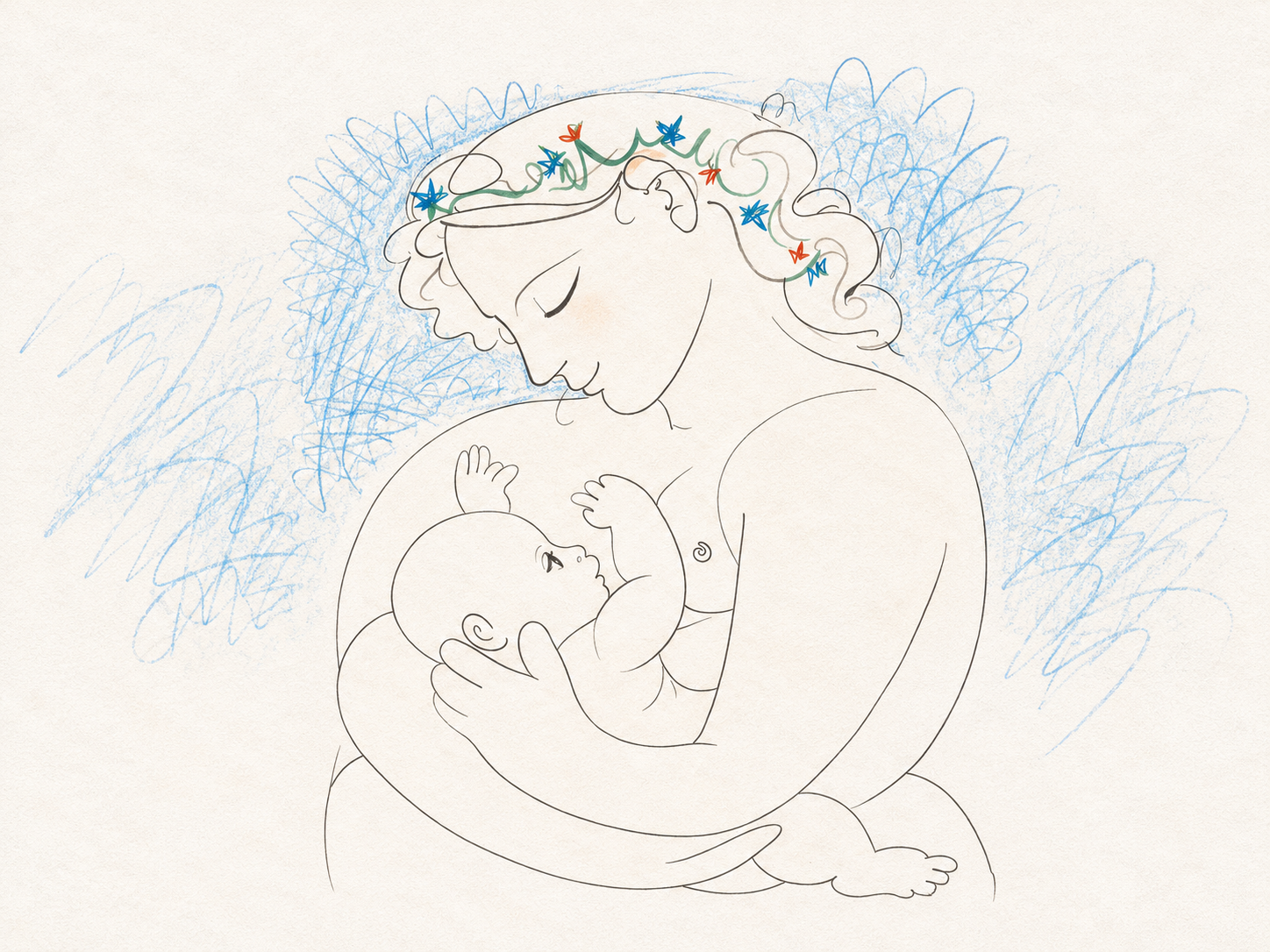
Behind it, a mother held her child against her.
Nothing extraordinary at first glance.
Two beings.
A silence.
One heartbeat against another.
Conscience whispered
— The first refuge.
Spirit watched the scene.
— A machine could reproduce that movement.
— Yes.
— It could imitate that voice.
— Yes.
— Even the beating of that heart.
The Creator smiled.
— No doubt.
Then he asked
— But could it choose to love that child more than itself?
Spirit fell silent.
The child opened its eyes.
The child did not yet know borders, walls, or the words “love,” “trust,” or “gratitude.”
And yet it was already learning them.
In warmth.
In a presence.
In two arms that said, without uttering a single syllable: “You can begin your life here.”
Conscience looked at the Creator.
— Is this, then, where humanity begins?
He looked at the mother and child.
— Perhaps it begins each time a fragile being discovers that it is not alone.
Where life begins.
In this first cradle of love.
In this first refuge, where long before understanding love, we already experience it.
The Creator looked once more at the mother and child.
Then gently closed the door.
One day, our machines may be able to reproduce almost everything about us. Our voices, our faces, our reasoning, our memories, even the appearance of our emotions.
But our humanity will always reveal itself elsewhere, in what no one can choose, feel or love in our place.
We all began life in a first refuge, where, for the first time, we discover that we can be fragile without being abandoned.
Perhaps growing up simply means this: becoming, in our turn, a refuge for someone else.
Because the most beautiful trace we can leave is not what the world will remember of us, but the love we have learned to pass on, and that will keep living after we are gone.
And if, because of us, someone feels a little less alone on this earth, then we will not merely have passed through life.
We will have passed on, in our turn, the light that was entrusted to us.
End and beginning.