BEYOND MEASURE
Never have we counted so much. Births, departures, achievements, seconds saved, mistakes avoided. As machines learn to replicate our actions and even some of our thoughts, an unsettling question arises.
In a world that measures almost everything, will we still know how to recognise what is beyond price? What if our greatest wealth were precisely what cannot be counted ?
Picture an elderly woman, alone in a hospital room.
A monitor tracks her heartbeat. Numbers describe her condition; algorithms might anticipate her needs. Everything appears to be under control. Yet when a nurse enters and gently takes her hand, her face lights up.
What has just happened will never appear in any statistics.
Perhaps this little scene captures the great paradox of our century.
Europe is growing older and its birth rate is falling, while several regions of Africa are experiencing remarkable population growth. Migration brings these worlds closer together, yet economics sometimes seeks to reduce their encounters to an equation of available labour and needs to be met.
Tomorrow, robotics will add another variable. Will we be asked to choose between a tireless machine and a precarious worker, as though comparing two quotations?
In our pursuit of the lowest price, we risk forgetting the worth of the person doing the work.
But respect for human dignity does not end at the workplace door. It also lives in the freedom to make one’s voice heard.
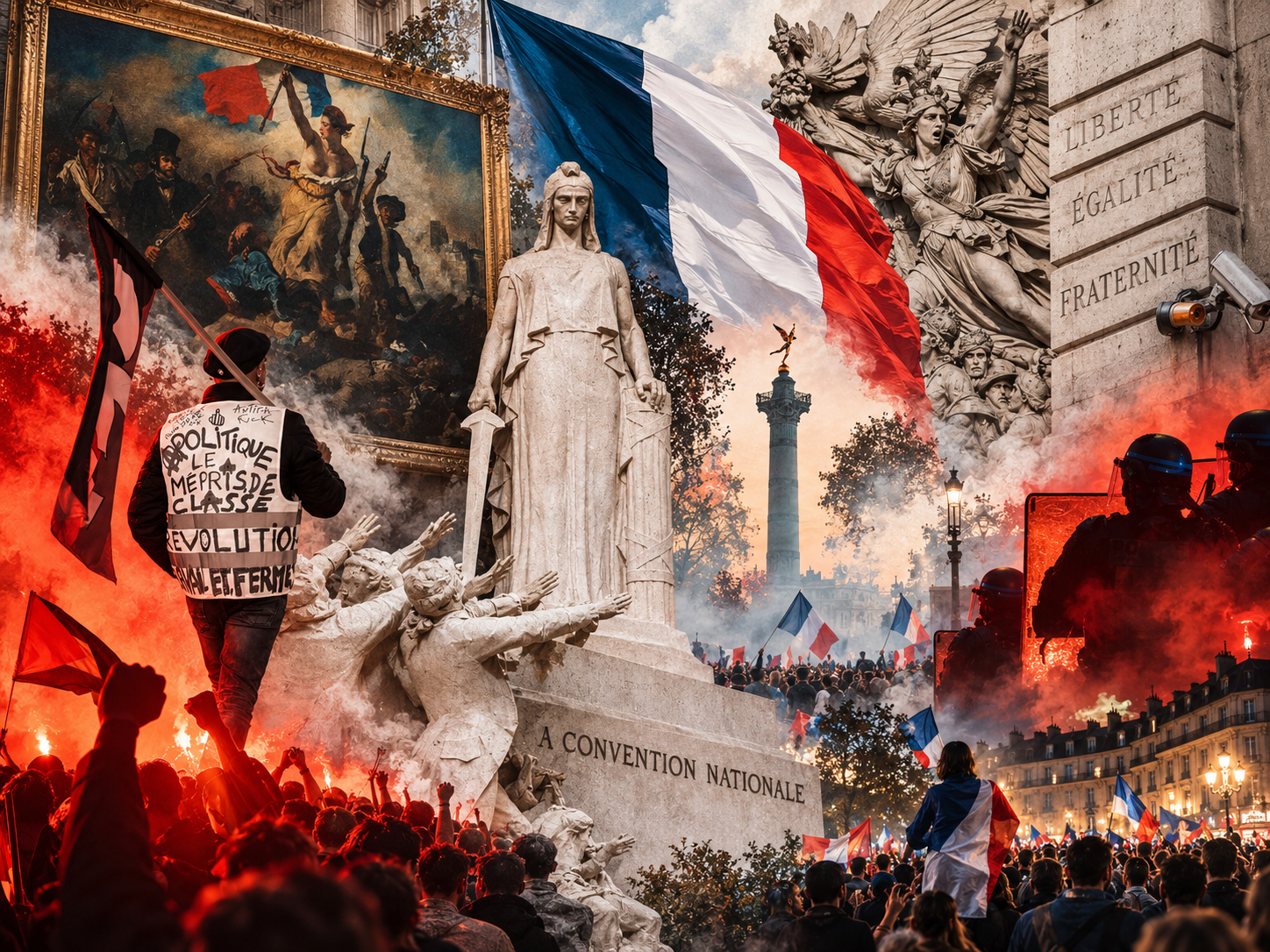
The demonstrations of 17 October reminded us of this other fragility. Amid reprehensible violence, ransacked shops and the concerns of peaceful protesters, the freedom to demonstrate remains a democratic imperative. Its protection must be reconciled with public order through measures that are necessary and proportionate.
A human being is neither a migration statistic, nor a labour cost, nor an arrest number.
We know how to count the years of a life, but not always the reasons for living.
And sometimes a life begins to change with almost nothing: a speck of dust around which something precious slowly takes shape.
Habits are like pearls.
An oyster can form a pearl when, in response to an irritation, it patiently lays down successive layers of nacre. From that slow accumulation comes a silken treasure.
It is not the wound that is precious, but what living things can sometimes build around it.
Our habits, too, grow around triggers, whether external or internal, that guide our behaviour.
A notification catches our eye. Boredom draws us towards a screen. Anxiety awakens an old reflex. Little by little, what once felt like a choice becomes a repetition.
Yet if fear and mistrust can become habits, trust, generosity and courage can also be cultivated.
These thoughts stayed with me during a magnificent Céline Dion concert, which I attended thanks to a childhood friend very dear to my heart.
Beyond the music, I found in her that admirable lesson in discipline and resilience. And her song, “On ne change pas” (“We Do Not Change”), brought me back to a profoundly human contradiction.
We are constantly changing. Our faces, ambitions and convictions evolve.
Yet beneath the costumes life invites us to wear, the child we once were remains, with all their dreams, wounds and innocence.
Science reminds us, particularly through epigenetics, that some mechanisms governing gene expression are influenced by our environment, without our biological inheritance being entirely fixed or everything lying within our control.
Perhaps growing up does not mean erasing our past, but learning to give it another shape.
The oyster does not always choose what irritates it. Yet it may turn that irritation into a pearl.
And what if this quiet wisdom invited us, too, to transform ourselves without abandoning what matters most, even as an unprecedented revolution reshapes our professions?
There is something quietly ironic, even exhilarating, about artificial intelligence entering the intellectual professions.
For years, machines replaced certain tasks on factory floors. We called it modernisation. Now that they can write, analyse and synthesise, a few prestigious certainties are beginning to tremble.
The machine was marvellous when it did other people’s work. It becomes unsettling when it draws up a chair beside our own.
Yet this revolution holds a promise: to make knowledge more accessible, challenge certain monopolies, and remind us that a title is no substitute for competence, just as competence is no substitute for conscience.
It was in this spirit that I conceived Creative Rights Companion (CRC), a human and technological venture devoted to intellectual property and creative rights.
This initiative is guided by a conviction shared in the wider movement of European legal innovation alongside Legal Data Space and AVOCAT+, a platform launched in October 2026 by France’s National Bar Council.
Technology must serve the law, not bend the law to its own logic.
A lawyer does far more than produce an answer. A lawyer listens, exercises judgement, protects others and takes responsibility for the advice given. Professional independence, legal professional privilege and data protection are not obstacles to progress. They are its safeguards.
The finest work often goes unseen. A conflict averted, a risk anticipated, an error prevented. We readily notice the case that goes wrong, but rarely the difficulties that never came to pass.
As the tenth edition of the Rendez-vous des Transformations du droit approaches in Paris on 24 and 25 November, this collective adventure takes on its full meaning.
Sovereignty cannot simply be proclaimed. It is built, patiently, by women and men who dare to act.
Identify. Create. Protect. Add Value. Pass On.
Five verbs for CRC. And a certain vision of the future.
For if machines can help us produce more, they also compel us to ask what gives our creations their depth: that mysterious quality which art has always sought to set vibrating.
At the 18th edition of the Romanian Film Festival in Nice, The Yellow Tie, a film about conductor Sergiu Celibidache, reminds us of a delicate truth.
Music is not merely heard. It is lived.
Celibidache distrusted recordings, convinced that they could never fully capture the singular encounter between the performer, the place, the audience and the moment.
Today, artificial intelligence can compose a melody, reproduce a voice, calculate a frequency. But can it recreate the full depth of an emotion simply by reproducing its form?
A trembling voice can move us more than a perfect note. A silence can say what no speech can express.
The law, too, knows this difference.
A lawyer may master the statutes, procedures and arguments. But when a client sits down across the desk, they bring more than a case file. They bring a story, a fear, sometimes an entire life on the verge of unravelling.
One may know the law perfectly and still fail to hear the person asking for justice.
Even the right answer must be given with care.
There is a resonance between human beings that no instrument can measure. It passes through a kind glance, a reassuring word, a hand that lifts someone who no longer dared to hope.
And perhaps it is in this quiet music, the music we make for one another, that our greatest wealth is found.
I would like to end with a thought for those whom our counters forget.
For the person who shares their bread while having too little themselves.
For the mother shielding her child from bombs.
For those who welcome someone in exile, the carer who stays beside a person through their final night, and those who have known violence yet refuse to pass it on.
For these women and men who sometimes have almost nothing, except the immense courage to remain kind.
For kindness is neither weakness nor naïveté. Sometimes it means resisting anger, overcoming fear, and recognising the humanity of someone the world has stopped seeing.
In their honour, let me tell a sweat fable.
The counter and the lantern
In a town by the sea lived a Counter who knew the price of everything.
He counted fortunes, goods, achievements and people. He could measure the world, which gave him the pleasant impression that he understood it.
Near the harbour, an old Lantern lit a deserted path each night.
How much do you earn?” the Counter asked her one evening.
Nothing,” she replied.
How many people owe you something for the light you give them?”
I have never counted them.”
Then what use are you?”
The Lantern said nothing. Some lights have no need to justify themselves.
That night, a little girl arrived from a country torn apart by war. All she had was an oversized coat and a crumpled drawing of a house beneath a star.
In the Lantern’s glow, she noticed an old man shivering with cold.
She had neither money nor food. So she sat beside him and slipped her small hand into his.
A passer-by saw them and offered his scarf. A woman opened her door. Someone else brought bread.
Gesture by gesture, the night grew less cold.
The Counter recorded a scarf, a meal and a place to sleep.
Then he stopped.
How could he count the dignity restored to a man? How could he measure the first smile of a child who had believed the world was closed to her?
I don’t understand,” he murmured. “They have given almost nothing.”
The Lantern answered softly.
You are looking at what they have lost. Look instead at what they have made possible.”
By morning, the little girl was sleeping peacefully, her hand still resting in the old man’s.
For the first time, the Counter understood that he had spent his life measuring what people possessed without ever seeing what made them great.
From that day on, whenever anyone asked where the town’s true wealth lay, he simply pointed to that small light beside the path.
The greatness of a heart is measured not by what it possesses, but by the courage it finds to bring light into the lives of others.
An end and a beginning.